Key Takeaways
The point where relaxed hair meets new growth can be vulnerable, but a steady routine can reduce avoidable stress while you transition.
- Handle the line between textures gently, especially when detangling.
- Cleanse and condition both textures without assuming they need identical care.
- Use small sections, plenty of slip, and low-tension styles.
- Limit heat and avoid applying relaxer to previously treated lengths.
- Choose a gradual trim or a big chop based on your preferences and how your hair is doing.
Understand why the line of demarcation is fragile
When you’re growing out a relaxer, two textures share one strand, and they may respond differently to brushing, moisture, and styling. The transition can be managed without rushing to cut off all the relaxed length. A little attention to where the textures meet can make everyday handling gentler. Mixed Nature’s hair-care education is written for the variety of textures and routines readers bring to their hair.
How the different textures meet at the line
The line of demarcation is the point where new, untreated growth meets the previously relaxed section. The natural portion may bend or coil differently from the straighter lengths, so a comb or finger moving through the hair can meet resistance at that boundary. That contrast does not mean something is wrong with your natural texture; it means the two sections may need different handling. Keep the meeting point supported when you detangle instead of pulling the hair taut from the roots.
Why new growth and relaxed ends need different handling
New growth and relaxed lengths can differ in texture, stretch, and how easily they tangle. Treating the whole head as if every section behaves the same can lead to tugging, especially when you try to smooth or stretch both textures at once. A flexible routine lets you adjust your approach by section: use enough conditioner or detangling product for slip, and take extra care at the boundary. If you’re weighing the emotional and practical sides of the process, this transitioning guide offers another perspective on what to consider.
How dryness, tension, and tangling can increase breakage
Dry-feeling strands may snag more readily, while repeated pulling, tight styles, or forceful combing can put extra strain on the hair. Knots are especially easy to worsen when you rush through them or pull from the scalp without supporting the section. Gentle handling matters most when a knot or style resists, not when everything is going smoothly. For broader guidance on reducing routine-related stress, see these hair-breakage prevention tips.
Build a balanced wash-day routine
Wash day does not need to be elaborate to be thoughtful. The aim is to cleanse the scalp, make the lengths manageable, and avoid leaving either texture coated or rough-feeling. Mixed Nature covers textured-hair routines with an inclusive approach, while your own hair’s response should guide the details. A simple sequence can help you notice what is working rather than changing several things at once.
Choose a gentle cleanser for your scalp and strands
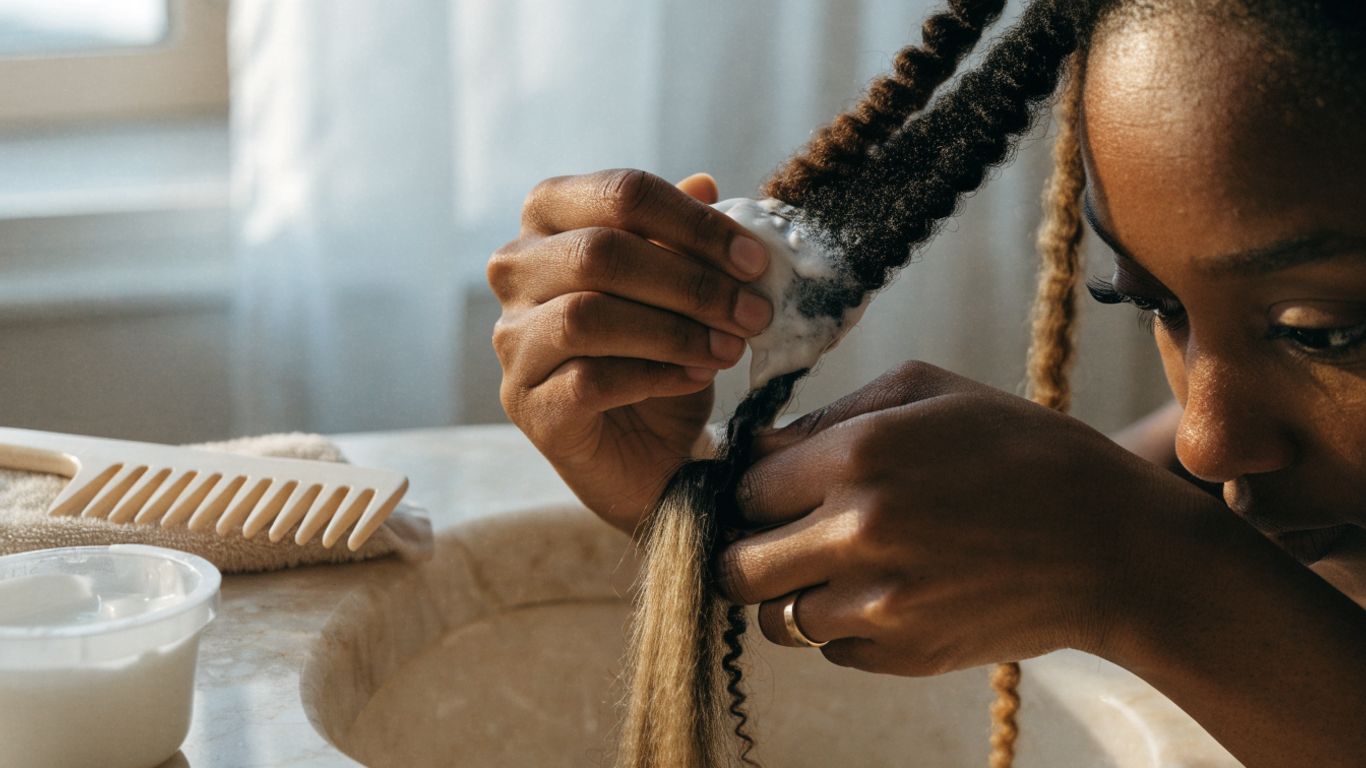
Focus shampoo on the scalp and let the lather rinse through the lengths rather than scrubbing the hair together. If you have buildup, cleanse thoroughly but avoid rough, repetitive friction at the line of demarcation. A wash routine should leave your scalp feeling clean without making the lengths difficult to handle. How often you wash can depend on your scalp, styling habits, and personal comfort.
Condition both textures without overloading your hair
Conditioner can make detangling easier by adding slip, but applying a heavy amount repeatedly may leave some hair feeling coated. Work it through in sections and pay attention to how the roots and ends feel after rinsing. The table below is a starting point for noticing what each part of wash day is doing; it is not a rule that every head needs the same schedule.
| Wash-day step | What to focus on | What to notice |
|---|---|---|
| Cleanse | Scalp and roots | Whether the scalp feels clean and comfortable |
| Condition | Mid-lengths and ends | Whether strands feel easier to separate |
| Rinse | All sections | Whether residue or heaviness remains |
| Detangle | Small, conditioned sections | Whether the line catches or resists |
Use those observations to make small adjustments, such as using less conditioner or spending more time rinsing. If your hair feels coated, you may not need to add another product; if it catches while detangling, pause and add slip rather than forcing the comb through.
Use protein treatments carefully and watch how your hair responds
Protein treatments are not automatically necessary for everyone, and more frequent use is not automatically better. If you choose one, follow its directions and notice how the hair feels afterward, including whether it seems easier or harder to manage. Keep other routine changes steady so you can tell what may have made a difference. If you have persistent scalp or hair concerns, a dermatologist or trichologist can help assess them.
Detangle and handle your hair with care
Detangling is often where the difference between the two textures becomes most noticeable. Give yourself enough time to work patiently, and avoid treating a snag as something to overcome by force. Small sections and a comfortable amount of slip can make the process more manageable. Mixed Nature also offers gentle detangling guidance for textured hair.
Work in small sections from the ends upward
Separate the hair into sections you can comfortably hold, then begin loosening tangles near the ends before moving toward the roots. When you reach a knot, hold the section above it so the pulling force does not travel up the strand. This gradual approach gives you a chance to stop and add more slip if needed. There is no prize for finishing quickly; a slower pass is often kinder to the hair.
Use slip and the right tools to reduce snagging
A wide-tooth comb or your fingers may work well, depending on your hair and what feels comfortable. Choose a tool that moves through the section without catching repeatedly, and keep the hair damp or conditioned if that makes it easier to separate. If you are comparing options, this overview of detangling brushes for mixed hair discusses features and gentle-use considerations. The right tool should help you work carefully, not encourage you to pull harder.
Keep your hands gentle when hair is wet or tangled
Wet hair can feel more pliable, but a saturated, tangled section still deserves a light touch. Avoid raking through knots with your fingers or stretching a section until it snaps back. A short sequence can keep the task calm and repeatable:
- Apply conditioner or another suitable detangling product for slip.
- Separate the hair into small, manageable sections.
- Loosen knots from the ends upward while supporting the section above them.
- Pause if a knot resists, then add slip or gently separate it with your fingers.
After detangling, keep sections organized as you move through the rest of wash day. If the same spot keeps catching, make a note of it and adjust your technique next time rather than assuming you need to pull more firmly.
Choose styles that protect without adding tension
A protective style should make daily handling easier without placing constant strain on the roots or lengths. Styles that allow both textures to sit comfortably may be more useful than ones that require forceful blending. Mixed Nature’s styling inspiration makes room for different textures and personal preferences, rather than treating one finish as the goal. Consider comfort and ease of maintenance alongside appearance.

Try low-manipulation styles that accommodate both textures
Twists, loose buns, or other simple styles may reduce how often you handle your hair, provided they do not pull tightly. You can also choose a style that lets the textures coexist instead of repeatedly heat-styling the new growth to match the relaxed lengths. Think about how easily you can refresh or take down the style without snagging the demarcation line. A style is only protective in practice if you can wear and remove it gently.
Avoid tight braids, ponytails, and heavy extensions
A style that feels tight or causes discomfort is a reason to loosen or remove it rather than wait for it to become easier. Heavy additions can increase pulling, and tight ponytails or braids may concentrate tension around the hairline and roots. Watch for tenderness or persistent pulling sensations and choose a less restrictive option. The goal is not to endure a style; it is to make your routine easier on the hair.
Rotate styles and give your scalp breaks between installs
Keeping one style in for a long time can make it tempting to overlook discomfort or buildup. When you take a style down, handle the hair slowly and check how the lengths and scalp feel before installing another. Breaks also give you a chance to wash, condition, and notice whether a particular style leaves short broken hairs. If something repeatedly causes strain, leave it out of the rotation.
Limit heat and chemical stress
Heat and chemical services can add another source of stress while you are managing two textures. You do not have to make every styling choice at once; reducing repeated or overlapping treatments can be a practical first step. Pay attention to how your hair responds, especially at the line where the textures meet. For support with the transition itself, you can also read these tips for transitioning without breakage.
Use heat sparingly and protect your hair when styling
Frequent heat styling can make it harder to handle already-fragile lengths, particularly if you are using heat to make new growth match relaxed ends. If you do use heat, follow the tool’s instructions, use a heat protectant suitable for your hair, and avoid repeatedly passing over the same section. Heat-free styles can be an alternative when they work for your schedule and desired look. Choose the approach that lets you handle the hair without rushing or pulling.
Avoid overlapping relaxer applications onto previously treated hair
If you continue relaxing new growth during your transition, take care not to apply relaxer over lengths that have already been treated. The previously relaxed hair has already undergone chemical processing, and overlapping can place extra stress on it. Because applying a relaxer can be difficult to do precisely, consider seeking a qualified professional if you are unsure how to separate new growth from treated lengths. Do not try to correct a missed or uneven application by repeatedly processing the same section.
Consider whether touch-up timing is adding stress to your strands
There is no single touch-up interval that suits everyone, and this article cannot determine a safe schedule for your hair. Think about whether the timing of services leaves you repeatedly stretching, combing, or applying chemicals to the boundary between textures. If you notice persistent breakage or scalp discomfort, pause further chemical processing and consult a qualified professional. A transition can continue at a pace that feels manageable for you.
Track breakage and adjust your transition plan
A few brief notes can reveal whether a change in handling or styling is helping. Look for patterns over time instead of judging your hair by one wash day or one style. Mixed Nature’s focus on accessible hair education is a reminder that routines should fit the person wearing them, not a single template. You can keep the process simple: record what you did and what you noticed.
Tell shedding apart from breakage at the line
Shedding usually involves a full-length hair that has come away from the scalp, while breakage tends to leave shorter pieces without a visible root end. It can be hard to tell at a glance, so note the length and where you see the strands rather than drawing a firm conclusion from one instance. If you are seeing ongoing thinning or scalp changes, seek advice from a dermatologist or trichologist; holistic perspectives on hair loss discuss approaches that are distinct from assessing breakage at the line.
Notice which routines or styles leave short broken hairs
Write down the style, detangling method, and wash-day steps around the times you notice short pieces. A simple record helps you compare routines without changing everything at once. The general value of keeping consistent records also appears in contexts far removed from hair care, such as time tracking in Azure DevOps; here, the useful habit is simply noting what happened and when. Likewise, reputation management tips concern a different subject, but also involve noticing patterns and responding to them.
When reviewing your notes, look for repeated associations rather than blaming a single product or style immediately. If one method regularly leaves the same area snagged, change that step first and see whether the pattern shifts. If your hair concerns include thinning rather than only short broken strands, you might also encounter traditional approaches to hair loss in general reading, but a clinician is best placed to assess persistent changes.
Choose between trimming gradually and cutting off relaxed ends
A gradual trim removes relaxed length over time, while a big chop removes most or all of it sooner. Neither choice is automatically better for everyone. Consider the length you want to keep, the effort of managing two textures, and how your ends are holding up. The decision belongs to you, not to a trend or a deadline.
If you prefer to transition gradually, schedule trims at a pace you can maintain and reassess as the natural growth gets longer. If you would rather remove the relaxed ends at once, plan for the cut and choose styles that feel comfortable afterward. Outside hair care, practical decisions can involve other kinds of support too, such as hourly estate-sale assistance; that is a separate service, but a reminder that timelines and help depend on the task at hand. For another view of the transition process, this complete transition guide covers gradual trimming and cutting off relaxed ends.
Conclusion
The most useful answer to how to prevent breakage at the line between relaxed and natural hair is to reduce strain wherever you can: cleanse and condition thoughtfully, detangle in sections, choose comfortable styles, and avoid unnecessary heat or overlapping chemical processing. Keep track of what your hair is telling you, then adjust at a pace that feels realistic. Whether you trim gradually or cut off the relaxed lengths, the right plan is the one you can follow with care.
Frequently Asked Questions
Why does hair break at the line between relaxed and natural hair?
The textures may differ in how they bend and respond to tension, so the boundary can catch during detangling or styling. Gentle handling and support at that point may help reduce avoidable pulling.
Can I transition without cutting off all my relaxed hair?
Yes. You can keep the relaxed lengths while natural growth comes in and trim the treated ends gradually. This takes time and may require extra care when managing both textures.
How should I detangle transitioning hair?
Work in small sections, add enough slip to help strands separate, and begin at the ends before moving toward the roots. Pause if a knot resists instead of pulling through it.
Should I use protein treatments during a transition?
Not everyone needs the same treatment schedule. If you use a protein treatment, follow its directions and pay attention to how your hair feels afterward rather than assuming more frequent use is better.
Are protective styles always helpful during a transition?
No. A style can reduce daily manipulation, but tight braids, heavy extensions, or a painful ponytail can add tension. Choose comfortable styles that you can remove gently.
Is a big chop better than trimming gradually?
Neither option is best for every person. A big chop removes relaxed lengths sooner, while gradual trimming preserves length as the natural hair grows; your preferences and hair condition can guide the choice.
When should I ask a professional about breakage?
Consider consulting a dermatologist or trichologist if breakage persists, you notice ongoing thinning or scalp changes, or you are unsure how to manage chemical services safely.